This article nearly became the wrong article.
The first version was accurate. It explained the difference between automation and agent-assisted work. It had the right terms, the right structure, and the general mood of a person who owns three monitors and says "operational architecture" without blinking.
Useful? Almost.
Readable? Let us be kind and say it had potential.
That is why this article is a good example. The way it changed explains the difference better than a definition could.
The Draft Arrived Wearing a Tie
The original draft tried to explain a business idea using system language.
It was accurate enough to survive a meeting and stiff enough to make the reader consider leaving one.
Accurate but unhelpful writing is trickier.
It can sound impressive while still leaving the reader thinking: "Fine, but what does this mean for my business on Monday morning?"
Most business owners want a clear answer to a practical question: why does work still feel heavy when they already have tools, forms, emails, dashboards, reminders, and enough notifications to make a phone vibrate itself into another postcode?
So the article needed a different job.
It needed to show the difference between moving work around and actually improving the work.
What Automation Would Have Done
Basic automation is useful. It follows a rule.
When a draft is created, send a message.
When a form is submitted, send an email.
When a lead signs up, add a row to a sheet.
That is helpful. It saves time. It stops small tasks from depending on memory, luck, or whoever last had coffee.
Automation usually leaves the quality judgement to a person.
If the draft is too technical, automation can still send it.
If the title is dull, automation can still move it to the next column.
If the article sounds like it was written for a committee that only communicates in acronyms, the committee draft can sail straight into the publishing queue.
Automation moves the task. Quality remains a separate job.
What Agent-assisted Work Did Instead
Agent-assisted work is different because it helps prepare the next useful step.
In this case, the draft entered a review step after the words appeared on the page. A page can contain plenty of words and still fail to communicate. Anyone who has read a software manual knows this in their bones.
The workflow helped check the article against the audience.
Is the story clear?
Is the language simple enough?
Does the piece read like a blog someone would choose to finish?
Does it explain the idea without making the reader feel underdressed for a boardroom?
Could it become a social post, a newsletter note, or a useful reference later?
That is the important shift.
The system moved the draft forward after helping to prepare the thinking around it.
Where the Human Still Matters
This is where agent-assisted work is often misunderstood.
The goal is controlled preparation, with a person deciding what gets published. Nobody is giving the intern the company passwords and a strong espresso.
The system can draft, review, compare, suggest, organise, track, and prepare.
The human still decides.
That matters because writing carries taste, judgement, positioning, and trust.
A system can say: "This article may be too technical."
A person decides: "Yes, change the angle."
A system can prepare a clearer version.
A person decides whether it sounds right.
The human moves to the part of the work where judgement matters most.
Then the Image Had to Earn Its Place
The article also needed an image.
The brief ruled out the familiar image of a random person pointing at a laptop. Technically acceptable is often where the trouble starts.
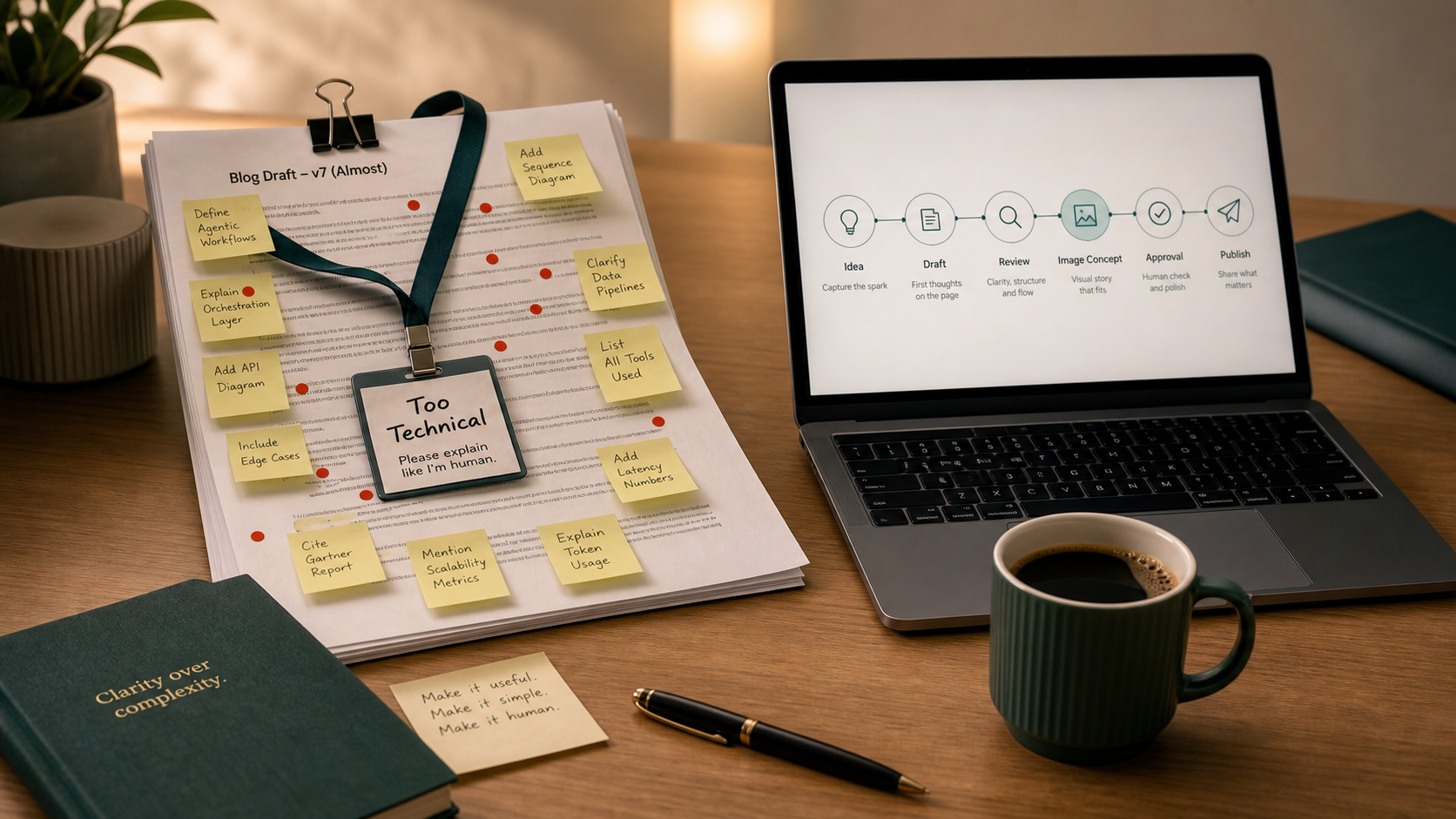
The image had to carry the same joke as the article: the draft had dressed for a board meeting and arrived at a normal conversation.
So the workflow turned the article into an image brief.
The brief asked for a warm desk scene. On one side, an overworked draft covered in red review dots and sticky notes. On the other, a cleaner workflow moving from idea to draft, review, image concept, approval, and publish.
Then came the small joke: a lanyard on the draft that says "Too Technical."
That detail makes the idea visible before anyone reads a paragraph. The image helps the article explain itself with fewer words.
The first job of the image was to help the reader feel the difference between a messy draft being moved along and a piece of work being shaped into something useful.
The Same Pattern Elsewhere
The same pattern applies outside writing.
When a lead comes in, automation can send an email. Agent-assisted work can prepare the context and the next action.
When a website page needs updating, automation can notify someone. Agent-assisted work can check whether the page still fits the message before it changes.
When an e-commerce store needs attention, automation can flag low stock. Agent-assisted work can prepare the fix and ask for approval where money or brand risk is involved.
None of this requires the system to become a mysterious black box with a dramatic soundtrack.
It just means the work is being prepared before it reaches the person responsible for the decision.
The Simple Difference
Here is the clean version.
Automation follows an instruction.
Agent-assisted work helps run a process.
Automation says: "When this happens, do that."
Agent-assisted work says: "Here is what happened, here is what it likely means, here is the next useful step, and here is where a human should approve."
Automation is great when the task is simple and predictable.
Agent-assisted work is better when the task has context, judgement, follow-up, or risk.
Most businesses need both.
The problem starts when people expect basic automation to behave like an operating model. That is how a company ends up with twelve tools, five dashboards, thirty notifications, and one tired person trying to remember what all the red dots mean.
The Takeaway
More automation would have moved the same draft faster. A better workflow changed the draft.
The first draft marked the start of review. It still needed a clearer angle, a better image, simpler language, and a human judgement call.
That is the difference.
Automation moves work.
Agent-assisted operations prepare work.
The strongest version combines system preparation with human judgement. The system prepares the work, including the words and the image, while people stay focused on trust, direction, and approval.
That is the operating model Cloudcor is building around.
“Automation follows an instruction. Agent-assisted work helps run a process.”
Build the operating model behind the work
If your business already has tools but the work still depends on manual chasing, repeated admin, and too many loose ends, Cloudcor can help design agent-assisted workflows where the system prepares the work and people stay in control of what matters.