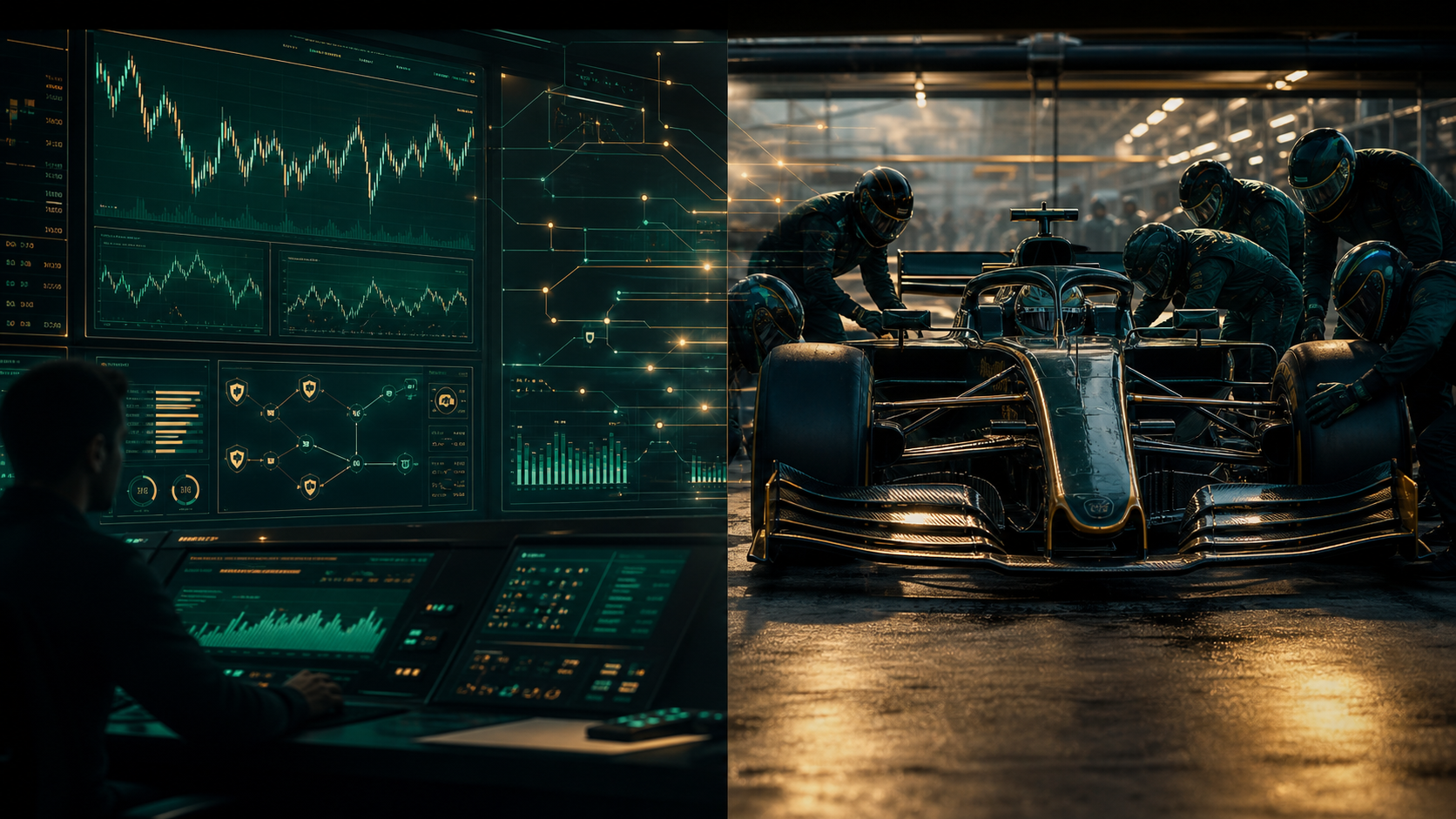
The Problem: Speed Without Control
Every trader who has considered automation imagines the same scene: the system is running, the market is moving, and there is no one at the wheel.
Speed without control is a car with no brakes, a plane with no pilot.
The fear appears when the system keeps working after its judgement has gone wrong.
The Analogy: A Formula 1 Car with Traction Control
A Formula 1 car is designed to go faster than any human reaction time. It has a team of analysts that run the strategy, a pit crew that manages the car, and an engineer that adjusts the telemetry.
The critical feature is that none of the team can casually take over everything. They can suggest, they can warn, and they can help prevent a crash, but authority is separated.
The Problem with Rogue Automation
A monolithic trading bot combines suggestion and execution inside the same piece of software.
A single piece of software runs the strategy, opens the trade, adjusts the stop loss, and closes the position. If the strategy is flawed, the system has no mechanism to stop itself. It is equivalent to a Formula 1 car with no brake pedal, running on a track with no pit crew, no telemetry, and no traction control.
The Solution: Separation of Powers
The MT5 agentic trading system is designed as a Formula 1 team for the market. Multiple agents, each with a strictly defined role, none of which can act alone.
The Analyst works like the pit crew. It analyses market data, reads the news, and evaluates signals. It cannot trade and cannot place an order. It provides traction control warnings, such as: the market is about to lose grip.
The Risk Governor works like traction control. It evaluates every potential trade against a set of rules and can block anything outside the safety parameters. Its authority is limited to enforcing those boundaries.
The Trader works like the driver. It places the order on the broker and receives only trades that passed the Analyst's review and the Risk Governor's approval.
The Observer works like the engineer. It watches the entire system, tracks performance, and suggests improvements. It cannot modify parameters and cannot change rules while the system is live.
The News Reader works like track conditions. It reads news, economic reports, and market signals. It adjusts the traction control based on the environment: looser when the market is calm, tighter when volatility is high.
The Result: Speed With Safety
The system operates at high speed, executing trades in milliseconds and running 24/7. But it never operates alone. Every trade is a collaboration: the Analyst suggests, the Risk Governor approves, and the Trader executes.
If a major market event occurs, such as a geopolitical crisis or a sudden crash, the News Reader flags the risk, the Risk Governor tightens safety parameters, and the system either pauses or significantly reduces position size.
The system reads the track and adjusts its risk posture.
The Result: The Numbers
Before, a trader was watching the screen 16 hours a day, emotionally drained, and one bad trade away from a 20 percent drawdown.
After, a governed system completed 190 trades with zero execution errors. Maximum drawdown was only 6 percent, or £30.72 on a £500 account. The system wins 37.7 percent of the time, but the wins are nearly twice as big as the losses, at +1.48R versus -0.77R.
The human reviews the Monday briefing in 30 minutes. The system handles the rest.
The Bigger Lesson
The trading story is an example of governed autonomy.
Any fast workflow becomes risky when one system can recommend, approve, and execute without separation. The safer model is different. One part reads the situation. One part checks risk. One part acts only when allowed. One part observes the result.
That pattern can apply to trading, pricing, compliance, supply chains, customer operations, or any workflow where speed matters but mistakes have consequences.
“The system reads the track and adjusts its risk posture.”
Start automating with governance
A strategy can be automated with separate authority for advice, risk approval, execution, and oversight. The related case study shows how those boundaries were designed.